


The O-1 visa is a US work visa for people with extraordinary ability in the sciences, education, business, athletics, or the arts. A US employer or US agent has to file it for you. In 2026 the filing fee is $1,055 plus a $600 Asylum Program Fee, and the initial stay is up to three years.
Not sure whether your record clears the bar, or what filing costs? See who qualifies for O-1A and O-1B, the criteria USCIS applies, every 2026 government fee, and how long approval takes.
Key Takeaways
- Who qualifies? Individuals able to demonstrate extraordinary ability in their field. O-1A covers the sciences, education, business, and athletics; O-1B covers the arts and motion picture or television work.
- How much? The filing fee is $1,055, plus a $600 Asylum Program Fee for most employers. Premium processing is optional and costs $2,965.
- How long? Regular processing can run up to about 12.5 months as of mid-2026. Premium processing gets a decision in about 15 business days.
- Important: You can NOT file an O-1 petition for yourself. A US employer or US agent must petition on your behalf. This is the single biggest difference from an EB-1A green card, where you can self-petition.
- Need help? Ellis attorneys build the petition and track your case start to finish. Start here →
What is an O-1 visa?
The O-1 is a temporary US work visa for people at the top of their field. O-1A covers extraordinary ability in the sciences, education, business, or athletics. O-1B covers extraordinary ability in the arts, plus a separate track for motion picture and television work (O-1B MPTV).
There is no annual cap on O-1 visas. The H-1B runs on a yearly lottery with a fixed quota; the O-1 does not. A petition can be filed any time of year, and USCIS never runs out.
O-1A vs O-1B vs O-2 vs O-3
The O category also covers support staff and family.
Classification | Who it covers | Key point |
|---|---|---|
O-1A | Extraordinary ability in sciences, education, business, or athletics | 8 evidentiary criteria; meet 3 or hold a major award |
O-1B | Extraordinary ability in the arts, or extraordinary achievement in motion picture/TV | 6 evidentiary criteria; MPTV has its own stricter rules |
O-2 | Support personnel essential to an O-1's performance in athletics, the arts, or MPTV | Must be an integral part of the performance, with critical skills |
O-3 | Spouse and unmarried children under 21 of an O-1 or O-2 | Dependents may study in the US, but may NOT work |
Who can file your O-1 petition?
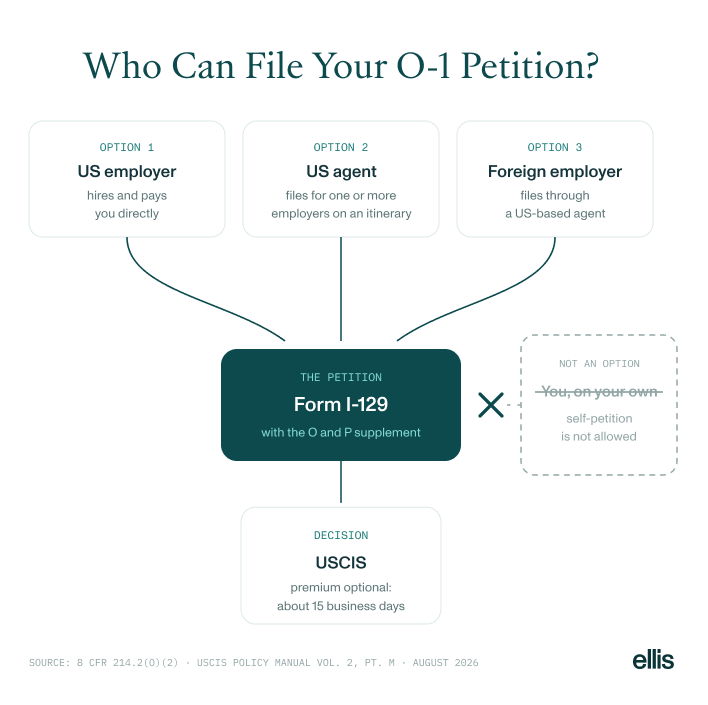
You cannot petition for yourself. A US employer, a US agent, or a foreign employer filing through a US agent must file for you. The petition is Form I-129, Petition for a Nonimmigrant Worker, with the O and P classifications supplement.
A US agent is a person or company in the US that files for you. The agent does not have to be your employer. Agents often file for people who work with multiple employers or on a set list of engagements, called an itinerary. This is common in the arts, athletics, consulting, and among startup founders. A US company you founded can also generally petition for you if it is a legal entity separate from you.
One caution: agent scams are on the rise. Red flags include guaranteed approval, ready-made itineraries or engagement letters for work that does not exist, and charges for the job offer itself. USCIS treats fake engagements as misrepresentation. That can mean denial, revocation, and a fraud finding that follows you into every future application.
A petition can be filed up to one year before the work begins, and USCIS suggests filing at least 45 days before the start date.
The 8 O-1A evidentiary criteria
There are two ways to qualify. A one-time major internationally recognized award, such as the Nobel Prize, is enough on its own. The more common path requires an O-1A petition to meet at least three of eight criteria:
- Nationally or internationally recognized prizes or awards for excellence in the field
- Membership in associations that require outstanding achievement, as judged by recognized experts
- Published material about you in professional or major trade publications or major media
- Participation as a judge of the work of others in the same or an allied field
- Original scientific, scholarly, or business-related contributions of major significance
- Authorship of scholarly articles in professional journals or major media
- Employment in a critical or essential capacity for organizations with a distinguished reputation
- A high salary or other remuneration compared to others in the field
Each criterion has its own proof requirements, and one achievement can support several. Our real O-1 visa examples show how researchers, founders, and athletes combine judging, press, critical roles, and salary evidence to clear the bar.
The 6 O-1B criteria for the arts
O-1B has its own list. A significant national or international award, such as an Academy Award, Emmy, Grammy, or Director's Guild Award, or a nomination for one, qualifies on its own. Otherwise the petition needs three of the six criteria:
- Lead or starring roles in productions or events with a distinguished reputation
- National or international recognition for achievements, shown through critical reviews or other published material
- Lead, starring, or critical roles for organizations with a distinguished reputation
- A record of major commercial or critically acclaimed successes
- Significant recognition from organizations, critics, government agencies, or recognized experts
- A high salary or other substantial remuneration compared to others in the field
Motion picture and television petitions use the same six criteria, but under the higher extraordinary achievement standard. They also face a stricter evidence rule, covered next.
How USCIS actually decides: the two-part analysis
Meeting three criteria does not mean approval. Under the USCIS Policy Manual, officers decide O-1 petitions in two steps.
Step one is a checklist: does the record satisfy at least three criteria, or document a qualifying major award?
Step two is a judgment call: the officer weighs the totality of the evidence and decides whether the record as a whole meets the standard. That standard is top of the field for O-1A, distinction for the arts, and extraordinary achievement for motion picture and TV.
Step two is more subjective. A case can satisfy three or even four criteria and still be denied on final merits if the officer feels that the evidence behind each criterion is thin. For example, a profile in a small local outlet could count as published material at step one. At step two, an officer can call it weak proof of national recognition. The same goes for evidence like judging one competition, an award with limited proof it was selective, or reference letters that praise you without pointing to undeniable results.
This mirrors the final merits determination USCIS uses for EB-1A green card petitions. It works the same way here: the criteria get your case a full read. Final merits decides whether it is approved.
Comparable evidence
The criteria assume a traditional career, and USCIS knows they do not fit every job. If a criterion does not really apply to your field, the petitioner can submit comparable evidence: proof of similar weight that fits how the field works. For example, a founder whose field has no formal judging might show selective accelerator admissions or demo-day invitations instead.
The exception is motion picture and television work. Comparable evidence is allowed for O-1A and O-1B arts petitions, but NOT for MPTV petitions, which must fit the listed criteria as written.
The consultation requirement
Nearly every O-1 petition needs a written advisory opinion, called a consultation, from a peer group in the field. For many O-1A fields that means a professional association. If a labor union covers the occupation, the union is the usual source. The opinion describes the work and says whether the achievements fit the standard.
Motion picture and television petitions need two consultations: one from the appropriate labor union and one from a management organization with expertise in the field. If no appropriate peer group exists, USCIS may decide on the evidence alone.
How much does an O-1 visa cost in 2026?
The petitioner pays the filing fees; the visa integrity fee applies at the consular stage.
Fee | Amount | Notes |
|---|---|---|
Form I-129 filing fee (O classification) | $1,055 | $530 for small employers (25 or fewer full-time employees) and nonprofits, per 8 CFR 106.2 |
Asylum Program Fee | $600 | $300 for small employers, $0 for nonprofits; paid with the I-129 |
Premium processing (optional, Form I-907) | $2,965 | |
$250 | Applies to visas issued on or after October 1, 2025; adjusts with inflation |
A typical employer pays $1,655 in government fees, or $4,620 with premium. Attorney fees are separate and vary by case.
How long does an O-1 visa take?
Processing time depends on the service center and whether the petition uses premium. On regular processing, some service centers run up to about 12.5 months as of mid-2026. Current USCIS processing times are published by form and service center.
Premium processing is the predictable route. For $2,965, USCIS acts on the petition within about 15 business days of receiving Form I-907 (some USCIS pages say 15 calendar days). That action can be an approval, a denial, or a request for evidence (RFE). An RFE pauses the clock. It restarts once your response is in.
Getting the visa vs getting the status
An approved I-129 is not itself a visa. What happens next depends on where you are.
Someone already in the US can request a change of status as part of the petition. If USCIS approves it, they receive a new I-94 record and can start the O-1 work without leaving the country. No visa stamp is needed until the next international trip.
Someone outside the US goes through consular processing. That means filing Form DS-160, paying the visa fee, and attending an interview at a US embassy or consulate, where the O-1 visa goes into your passport.
The O-1 allows dual intent in practice. Under USCIS rules, seeking a green card is not by itself a reason to deny an O-1 petition or extension. It is one of the few work visas you can hold while openly working toward a green card.
How long can you stay on an O-1?
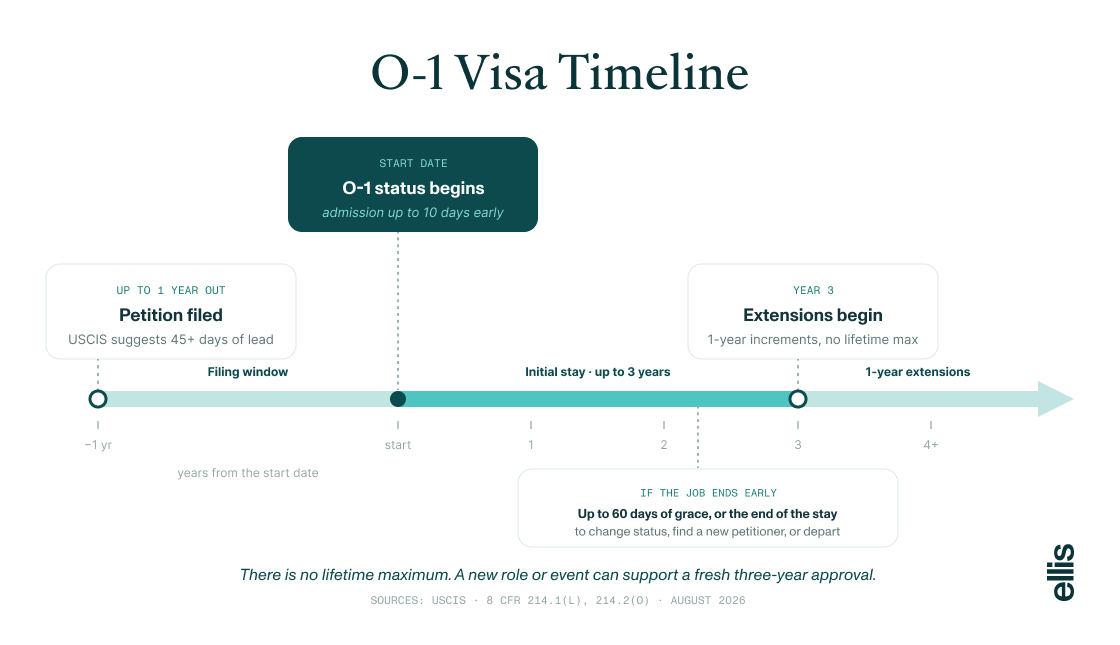
The initial approval covers the event or activity, up to 3 years. Extensions for the same event come in increments of up to 3 years, and there is no cap on total O-1 time. A new event or position can support a fresh 3-year approval. Some O-1 holders keep the status for many years this way.
Grace periods apply at both ends. You can enter the US up to 10 days before your validity period starts and stay up to 10 days after it ends, but you can only work inside the validity period. If the job ends early, regulations generally allow up to 60 days (or the end of your authorized stay, whichever comes first) to change status, find a new petitioner, or leave.
From O-1 to a green card
For many O-1 holders, the next step is the EB-1A green card. It uses a closely related extraordinary-ability standard, so the evidence built for an O-1 often becomes the base of the case. The key difference: you can self-petition for EB-1A, with no employer or agent, and approval leads to permanent residence instead of a temporary stay.
The EB-2 national interest waiver is the other common route. Its bar is lower than EB-1A's, it also allows self-petition, and researchers and founders whose work has national importance often file it alongside.
How Ellis can help
The O-1 is an evidence-heavy petition and comes down to how well the case is built. Our experienced attorneys evaluate your record against the criteria, prepare the consultation and evidence exhibits, and track the case from filing to decision in one place. Schedule a free consult →
This article is for general informational purposes only and is not legal advice.