Key Takeaways
- Who files? Anyone applying for a U.S. green card from inside the country with an approved I-130 or I-140 and a current priority date.
- Cost: $1,440 for adults, $950 for kids under 14 with a parent. Biometrics included.
- How long? 8 to 24 months for most cases. Backlogged categories run years longer.
- Should I use an attorney? Almost always, it’s recommended. The I-485 packet runs 100+ pages once supporting evidence is included, and many denials trace back to preventable errors. Schedule a free consultation with the immigration experts at Ellis today.
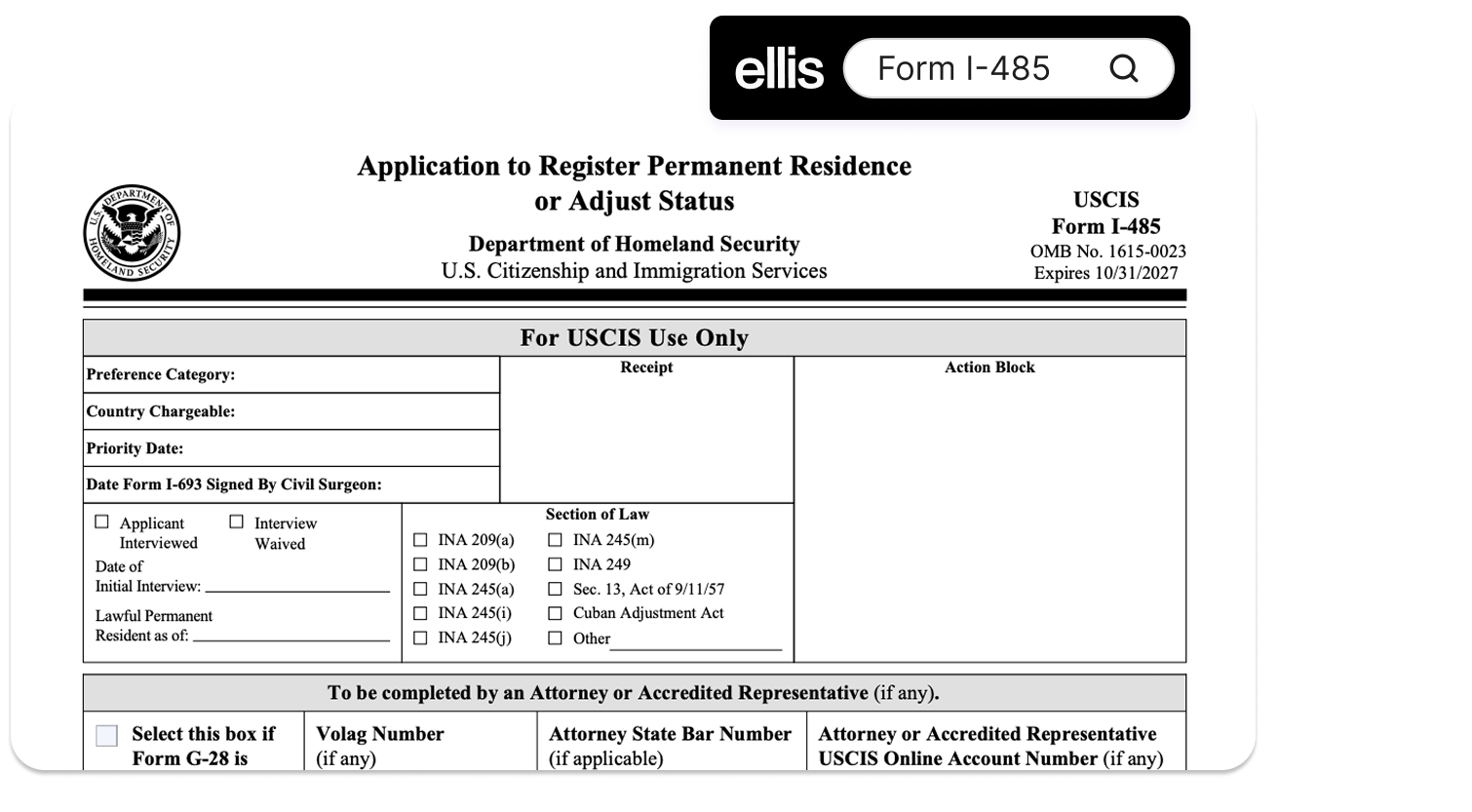
If you're already in the U.S. and want a green card, the path runs through one form: Form I-485. Officially called the Application to Register Permanent Residence or Adjust Status, it's how you turn your temporary status into permanent residence without leaving the country for a consular interview.
This guide covers what the I-485 is, who can file it, how much it costs, and what to expect after you file.
What is Form I-485?
Form I-485 is the USCIS application used by people inside the United States to become lawful permanent residents (green card holders). The process is called adjustment of status, or AOS. It's the alternative to consular processing, where you'd attend an immigrant visa interview at a U.S. consulate abroad.
You file the I-485 with USCIS along with a packet of supporting documents. The form itself is 22 pages. It asks about your immigration history, current status, eligibility category, family information, and any potential reasons you might be barred from a green card (criminal history or prior immigration violations, for example).
A successful I-485 results in a green card mailed to your U.S. address, usually within 1 to 2 weeks after the case is approved.
Who Can File Form I-485?
To file, you generally need to meet five requirements:
- A qualifying immigrant category. Family-based (spouse, parent, or unmarried child of a U.S. citizen, plus certain relatives of green card holders), employment-based (EB-1, EB-2, EB-3, EB-4, EB-5), special immigrant categories, asylees and refugees one year after grant, and several others.
- An approved or concurrently filed main petition. Form I-130 for family cases, Form I-140 for employment cases, Form I-360 for special immigrants, Form I-526 or I-526E for EB-5 investors. The I-485 cannot stand alone. It always rides on top of one of these petitions.
- A current priority date for categories with annual numerical limits. Most family preference and employment-based categories have backlogs. Check the monthly Visa Bulletin if you're affected.
- Lawful presence and admission to the U.S. Most applicants must have been formally admitted or paroled into the country, and must keep lawful status from admission through filing. Immediate relatives of U.S. citizens (spouses, parents, unmarried children under 21) are exempt from this status-maintenance requirement.
- No bars to adjustment. Certain criminal convictions, immigration violations, fraud, or unauthorized employment can stop you from filing even if you otherwise qualify.
Some categories let you file the I-485 concurrently with the I-130, which means at the same time. This saves months. Most employment-based applicants must wait for the I-140 to be approved first, or use concurrent filing when the priority date is already current.
Eligibility analysis itself is complicated. Prior immigration history, criminal record, periods out of status, or unusual employment circumstances can each trigger a bar to adjustment that isn't obvious from the form. Get attorney advice before assuming you qualify.
What Does the I-485 Cost in 2026?
The 2026 filing fee structure for Form I-485:
Applicant | Filing Fee | Notes |
|---|---|---|
Adult (14+) | $1,440 | Biometrics included |
Child under 14 (filing with a parent) | $950 | Biometrics included |
Child under 14 (filing alone) | $1,440 | Biometrics included |
A fee waiver (Form I-912) is available only for limited humanitarian categories like asylees, refugees, certain T and U visa holders, and VAWA self-petitioners.
The optional companion forms are free when filed at the same time as the I-485:
- Form I-765, the Employment Authorization Document (EAD), which is your work permit while the I-485 is pending
- Form I-131, Advance Parole, which is your travel permission while the I-485 is pendin
Both are renewable while the I-485 remains pending.
What You'll Need to File
A complete I-485 package usually includes:
- The completed I-485 form (22 pages)
- Two passport-style photos
- Birth certificate with certified English translation if it's not in English
- Passport biographic page plus copies of all U.S. visa stamps
- Your most recent I-94 arrival/departure record
- Main petition approval notice (Form I-797), or filing receipt if filing concurrently
- Medical exam (Form I-693) completed by a USCIS-designated civil surgeon, in a sealed envelope
- Form I-864 Affidavit of Support for family-based cases
- Filing fee
- Optional: I-765 (work permit) and I-131 (advance parole) filed at the same time
Once you've assembled it, the full packet usually runs 100+ pages. The packet is complicated. Each piece has its own form, its own evidentiary standard, and its own way of being rejected. The most common reason an I-485 hits a Request for Evidence (RFE) or denial isn't the I-485 itself. It's a missing translation, an outdated medical exam, an under-supported affidavit, or an inconsistency between forms. This is the single biggest reason most applicants work with immigration counsel.
The I-485 Process, Step by Step
- Confirm eligibility. Check that your priority date is current and your main petition is approved or eligible for concurrent filing.
- Gather supporting documents. Schedule your medical exam. Form I-693 is valid for 2 years from the civil surgeon's signature, so don't get it too early.
- Mail or e-file the package to the USCIS lockbox address for your category and state of residence. Verify the address on uscis.gov, since it changes. Some categories support online filing.
- Receive your Form I-797C Receipt Notice within 4 to 6 weeks confirming USCIS got your filing.
- Attend your biometrics appointment at an Application Support Center, usually 6 to 10 weeks after filing.
- Receive your EAD and Advance Parole in 8 to 12 months if you applied for them at the same time.
- Attend your interview if your case requires one. Family-based and many employment-based cases require an in-person interview at your local USCIS field office.
- Receive a decision. If approved, your green card arrives in the mail within 1 to 2 weeks. If denied, you'll receive a written explanation along with appeal or motion options.
How long does the I-485 take?
The wait depends on three things: your category, your country of birth, and the USCIS field office that gets your case. Here are typical 2026 ranges based on recent USCIS data.
Adjustment of status (filing inside the U.S.)
Category | Typical processing time |
|---|---|
Immediate relatives of U.S. citizens (spouse, parent, child under 21) | 10 to 14 months |
Employment-based with current priority date | 12 to 20 months |
Family preference (F1, F2A, F2B, F3, F4) | 18 to 30 months after the priority date is current |
Backlogged EB-2 or EB-3 India and China | 2 to 4+ years after the priority date is current |
The clock above only starts once your priority date is current. For backlogged categories, the full wait from petition filing to green card can run a decade or more. Track your category in the monthly Visa Bulletin, and check service-center-specific wait times on the USCIS processing times tool.
Consular processing (filing from abroad)
If you're outside the U.S., or in a category where AOS isn't available, the timeline runs through the National Visa Center (NVC) and a U.S. consulate.
Step | Typical wait |
|---|---|
NVC document review | 2 to 4 months after the fee bill |
Interview scheduling at U.S. consulate | 3 to 12+ months, varies by post |
Total time from petition approval to visa issuance | 12 to 30 months |
Consulate wait times vary widely. High-volume posts like Mumbai, Manila, Guangzhou, and Lagos run longer than low-volume posts in Europe or Canada. The State Department publishes current wait times for each post on its visa appointment wait times page.
For a deeper look at the consular path, see our consular processing guide.
I-485 vs Consular Processing
If you're outside the U.S., or in a category where AOS isn't available, you'll go through consular processing instead. This involves the National Visa Center (NVC) and an immigrant visa interview at a U.S. consulate abroad.
Adjustment of Status (I-485) | Consular Processing | |
|---|---|---|
Where you are | Already in the U.S. | Outside the U.S. |
Where you interview | USCIS field office in the U.S. | U.S. consulate in your home country |
Can travel during pending? | Only with Advance Parole (I-131) | Yes, but with rules |
Typical timing | 8 to 24 months | 12 to 24 months |
Can work in U.S. while pending? | Yes. File I-765. | N/A |
Family files with you? | Yes. Derivatives file their own I-485s. | Yes, through the same NVC process. |
What Happens After You File
Three common questions applicants ask after filing:
Can I work while my I-485 is pending?
Yes, once USCIS approves your concurrently filed I-765 EAD. That usually happens 8 to 12 months after filing. Many H-1B and L-1 visa holders also keep working on their underlying visa during the wait.
Can I travel while my I-485 is pending?
Generally only with Advance Parole, unless you hold a valid H-1B or L-1 visa. Departing without AP almost always abandons the application. Consult an attorney before traveling.
When will I get my green card?
Anywhere from 8 months to 4 or more years, depending on category, country of birth, and service center workload. Indian and Chinese applicants in EB-2 and EB-3 face the longest backlogs.
Final Tips
Form I-485 is the document that turns your time in the U.S. into a green card. The form itself is straightforward. The packet built around it (main petition, medical exam, affidavit of support, fees, optional EAD and AP) is genuinely complicated, and the packet is where most denials and delays start.
A few clear rules:
- File a complete packet. Half-assembled filings get RFEs, and RFEs cost months.
- Keep your status throughout. Falling out of status mid-process can sink the case.
- Never travel without Advance Parole. Departing without AP almost always abandons the I-485.
- Get immigration counsel before you file. This is not the kind of paperwork to learn on the fly. The I-485 packet is complicated, every form interacts with the others, and a single missing document can set you back six months.
Need help filing your I-485?
Ellis combines experienced immigration attorneys with a modern case management platform. Every I-485 we handle goes through structured workflows, automated checks, and full attorney review.
Schedule a free consultation today.